
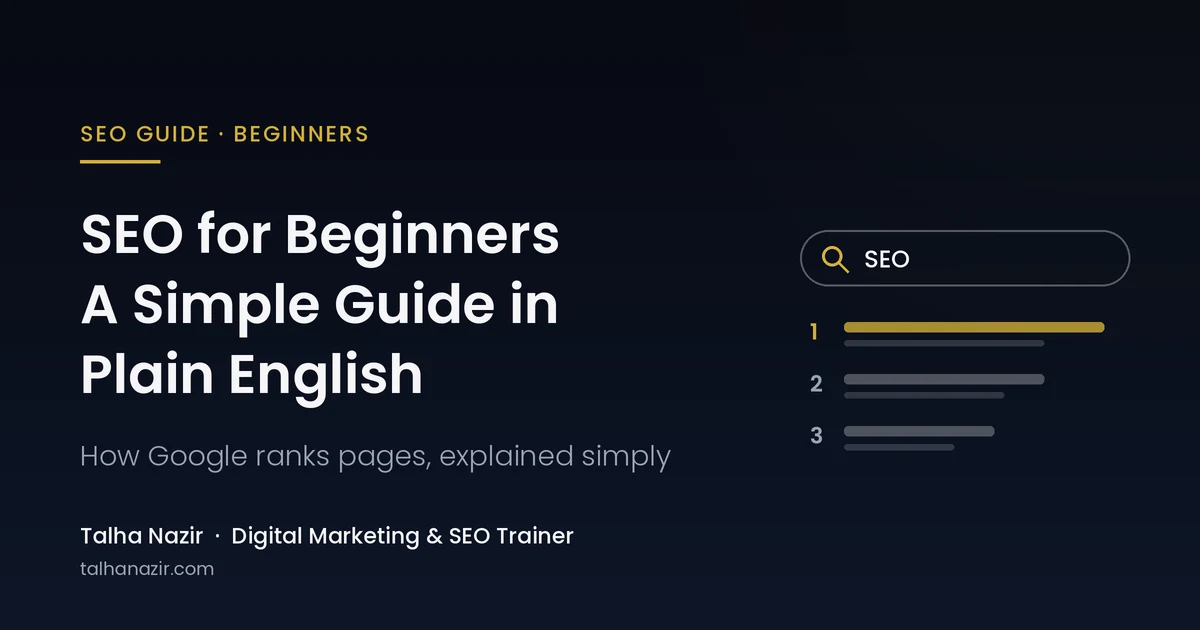
SEO for Beginners: A Simple Guide in Plain English
- Talha Nazir
- November 1, 2026
- SEO
- how SEO works, learn SEO in Pakistan, SEO for beginners, what is SEO
- 0 Comments
If you’re new to SEO, this guide is for you. SEO for beginners doesn’t have to be confusing. In simple words, SEO is how you help Google understand your website so the right people find it when they search. In this guide I’ll explain it in plain English, with examples from Lahore and the rest of Pakistan.
I’m Talha Nazir, a digital marketing and SEO trainer in Lahore. SEO is where my own career started, and I’ve since trained 5000+ students. These are the same basics I teach on day one of every class.
What you’ll learn in this post:
- What SEO is and why it matters for businesses in Pakistan
- How Google decides which pages to show first
- Keyword research basics, explained simply
- On-page, off-page and technical SEO, step by step
- What to do next if you want to learn SEO properly
What SEO is
SEO stands for search engine optimisation. It means improving your website so it shows up higher in Google’s free (organic) results for the searches your customers make.
Think of a bakery in Johar Town. When someone nearby searches “fresh cake near me” or “birthday cake Johar Town”, the bakery wants to appear on the first page. Ads can put it there for a fee. SEO can put it there for free, as long as the website deserves it.
Here is the difference in one line: with ads, you pay for every click. With SEO, you earn your place, and the clicks keep coming without paying per visit.
Why SEO matters in Pakistan
More people in Pakistan now search on their phones before they buy, visit or call. Students search for courses, families search for doctors and schools, and shoppers search for products before they order online with cash on delivery. If your business doesn’t appear in those searches, your competitor does.
SEO is also a strong skill for a career. Agencies in Lahore, e-commerce brands and freelance clients abroad all need people who can rank websites.
How Google ranks pages
Google’s job is to show the most helpful result for every search. To do that, it goes through three main steps:
- Crawling: Google’s bots visit pages on the web and follow links from one page to another.
- Indexing: Google stores and understands what each page is about.
- Ranking: when someone searches, Google picks the pages that best answer that search and puts them in order.
Google uses many signals to rank pages, and it doesn’t share the full list. But for beginners, the main ideas are simple:
- Relevance: does your page actually answer what the person searched?
- Quality: is the content helpful, clear and trustworthy?
- Authority: do other good websites link to you and mention you?
- Experience: does the page load fast and work well on a phone?
If you remember just one thing, remember this: Google wants to rank pages that help people. Every SEO task you learn is a way of making your page more helpful and easier for Google to understand.
Keyword research basics
A keyword is the word or phrase someone types into Google. Keyword research means finding the words your customers really use, so you can create pages that match them.
For example, a clothing shop might think its customers search “ladies apparel”. In reality, people in Pakistan are more likely to search “lawn suits”, “unstitched lawn 3 piece” or “eid dresses online”. If you use the wrong words, the right people won’t find you.
Understand search intent
Every search has a reason behind it, called search intent. Some common types:
| Intent | What the person wants | Example search |
|---|---|---|
| Informational | To learn something | what is SEO |
| Commercial | To compare options | best SEO course in Lahore |
| Transactional | To buy or book now | buy running shoes online Pakistan |
| Local | Something nearby | mobile repair shop near me |
Your page should match the intent. A person searching “what is SEO” wants a simple guide like this one, not a sales page.
Free ways to find keywords
- Type your topic into Google and look at the autocomplete suggestions.
- Scroll down to “People also ask” and related searches at the bottom of the page.
- Use Google Search Console to see which searches already bring people to your site.
- Use Google Keyword Planner (inside Google Ads) to get keyword ideas.
Start with longer, specific phrases. “SEO course for beginners in Lahore” is easier to rank for than just “SEO”.
On-page SEO
On-page SEO means the things you control on the page itself. This is where most beginners should start, because you can fix it today.
- Title tag: the blue clickable headline in Google. Put your main keyword near the start and keep it under about 60 characters.
- Meta description: the short text under the title. It doesn’t directly rank you, but a clear description gets more clicks.
- Headings: use one H1 for the main title, then H2 and H3 headings to break the page into sections. Include your keyword in at least one of them naturally.
- Content: answer the question fully and simply. Use short paragraphs, lists and examples.
- Images: compress them so they load fast, and add alt text that describes the image.
- URL: keep it short and readable, like /seo-for-beginners-guide/.
- Internal links: link to your other helpful pages so readers and Google can explore your site.
If your site runs on WordPress, a plugin like Rank Math or Yoast helps you check most of this without touching code.
Off-page SEO and links
Off-page SEO is everything outside your website that builds trust. The biggest part is backlinks: links from other websites to yours. When a respected website links to you, it’s like a recommendation.
But quality matters far more than quantity. One link from a real, relevant website is worth more than hundreds of spammy links. Never buy cheap link packages that promise “1000 backlinks”. They can hurt your site.
Safe ways for beginners to earn links and mentions:
- Create genuinely useful content that people want to share.
- List your business on trusted local directories.
- Set up and complete your Google Business Profile so you show on Google Maps.
- Get featured by local news sites, partners or suppliers you actually work with.
- Write guest posts for real blogs in your industry.
Technical SEO basics
Technical SEO makes sure Google can reach and read your website without problems. You don’t need to be a developer to understand the basics:
- Mobile-friendly: most searches in Pakistan happen on phones, so your site must work well on small screens.
- Speed: slow pages lose visitors. Compress images, use good hosting and a caching plugin.
- HTTPS: your site should have a security certificate (the padlock in the browser).
- XML sitemap: a file that lists your pages so Google can find them. Submit it in Google Search Console.
- No broken pages: fix links that lead to “404 not found” errors.
- Robots.txt: make sure you’re not accidentally blocking Google from important pages.
Use Google Search Console
Google Search Console is a free tool from Google. It shows which searches bring people to your site, which pages are indexed and what errors Google found. If you only set up one SEO tool this week, make it this one.
My experience: In my classes, beginners often try to learn every SEO trick at once and get lost. The students who improve fastest pick one small website, even a page for a relative’s shop, and apply one basic at a time: fix the titles, add useful content, set up Search Console, then watch what changes. Small, steady practice beats big theory every time.
Next steps: how to learn SEO in Pakistan
Here is a simple plan to go from beginner to confident:
- Read the official guide. Google’s free SEO Starter Guide on Google Search Central explains the basics straight from the source.
- Build a practice site. A simple WordPress blog about something you love is enough.
- Do keyword research for five topics and write one helpful page for each.
- Set up Google Search Console and check it every week.
- Get feedback from someone who does real SEO work, so you don’t build bad habits.
SEO takes patience. Results often take months, not days, so focus on doing the basics well and keep going.
If you’re still deciding whether this field is for you, read my guide on whether digital marketing is a good career in Pakistan. If you’re comparing classes, use my checklist on how to choose a digital marketing course in Lahore. You can also read what I learned teaching 5000+ students.
Want hands-on guidance? You can learn SEO with a Lahore trainer in my classes, where we practise on real websites with real tools. The next batch will be announced soon. Message me on WhatsApp and I’ll share the details as soon as they’re out. If you run a business and need SEO done for you, send me a message there too.
FAQs
What is SEO in simple words?
SEO (search engine optimisation) is the process of improving your website so it appears higher in Google’s free search results for the words your customers search. It covers your content, keywords, links and the technical health of your site.
Can I learn SEO on my own as a beginner?
Yes. Start with Google’s free SEO Starter Guide, build a small practice website and apply one basic at a time. A trainer or course helps you learn faster and avoid common mistakes, but practice is what makes you good.
How long does SEO take to show results?
It depends on your competition, your website and how consistently you work on it. For most new sites it takes months, not days. Be wary of anyone who guarantees first-page rankings in a week.
Is SEO a good skill to learn in Pakistan?
Yes. Businesses across Pakistan want more customers from Google, and freelance clients abroad hire SEO specialists too. SEO also pairs well with content writing, WordPress and Google Ads.
What is the difference between on-page and off-page SEO?
On-page SEO is what you change on your own pages, like titles, headings, content and images. Off-page SEO happens outside your site, mainly earning links and mentions from other trusted websites.
About the author: Talha Nazir is a Lahore-based digital marketing and SEO trainer at Corvit Networks and the founder of Ajax Solutions. He is Google Certified, has trained 5000+ students and was recognised by the Governor of Punjab for his contribution to digital education. Visit talhanazir.com.
Leave A Comment